
Why is AI stuck at the margins?
Plant CEOs know they have to use AI, but many of them see it only at the margins: a chatbot, a writing assistant, a pilot that never scaled. That raises the question of when AI will lead the development of the business process.
That feeling is right, and it isn't unique to one plant. BCG found in 2024 that 74% of companies struggle to achieve and scale tangible value from AI. Gartner predicts that more than 40% of agentic AI projects will be canceled by the end of 2027. And McKinsey found that, of 25 organizational attributes it tested, redesigning workflows had the biggest effect on an organization's ability to see EBIT impact from generative AI.
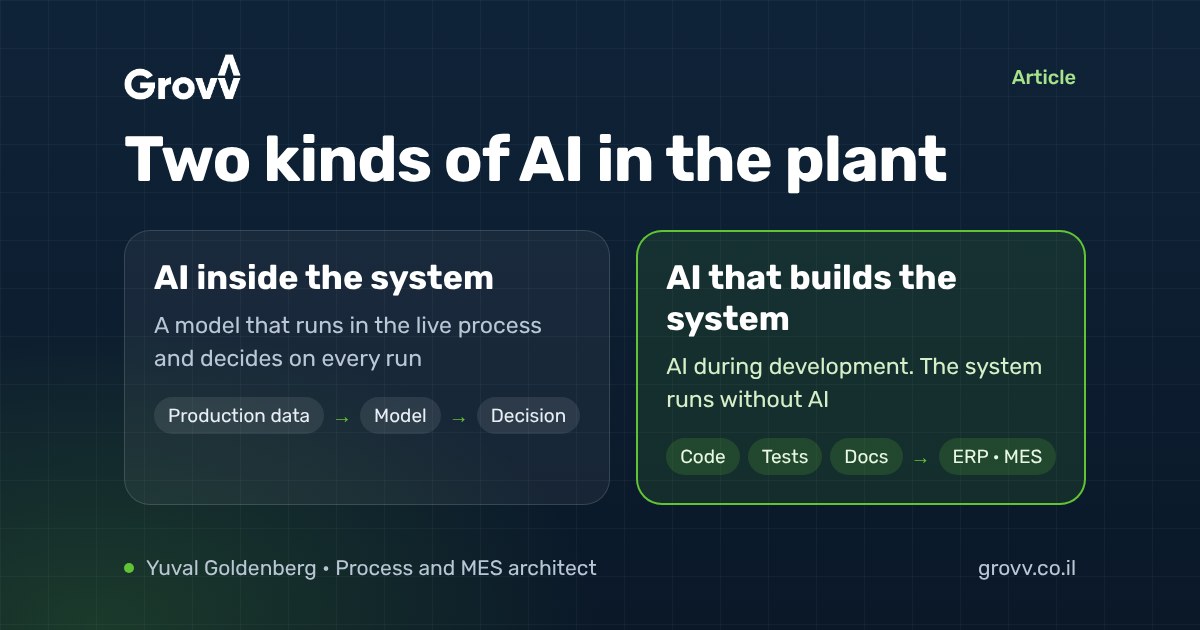
What is the difference between AI inside the system and AI that builds the system?
Talk of "AI at the core of the process" mixes up two different things.
AI inside the operational system is a model or agent that runs inside the live process. Examples are visual inspection, failure prediction, a maintenance knowledge assistant or a planning agent. Every run depends on the model, and production data passes through it.
AI that builds the system is a process expert and a developer using AI to write, test and document purpose-built, deterministic software around the ERP and MES. That software can be thin apps, integrations, decision tables, validations, alerts and guided work instructions. It then runs without any AI at all, and does the same thing every time.
AI inside the system
- Where it works
- In the live process, on every run
- When it fits
- When the input really needs a model: images, documents, free text
- Production data
- Passes through the model
- Main risk
- A wrong decision at run time, prompt injection, regulatory validation
- What it takes
- Connected data, a clear metric and a person who checks the output
AI that builds the system
- Where it works
- Only during development
- When it fits
- When the rules can be written down: validations, decision tables, alerts, work instructions, integrations
- Production data
- Need not leave the plant, because development uses code and sample data
- Main risk
- Familiar software risks, managed with automated tests and code review
- What it takes
- A precise specification, tests, and review by someone who knows the process
Why does this distinction change the picture?
Most of the "AI failure" statistics quoted today are about the first kind:
- MIT NANDA looked at generative AI tools that organizations deployed in their processes.
- Gartner is talking about agentic AI projects.
- BCG and McKinsey measure value from AI deployed in business functions.
Most of them are not about using AI to build ordinary software. And that distinction resolves the CEO's dilemma: you can bring AI into the core this year, without waiting for agents to mature, by building the core systems themselves.
AI-assisted development also has measured evidence behind it:
- In a controlled trial at Google, engineers saved about 21% of the time on a complex enterprise task.
- In three field experiments with 4,867 developers at Microsoft, Accenture and a Fortune 100 electronics manufacturer, developers working with AI completed about 26% more tasks.
The effect depends on context. In a 2025 METR study, experienced developers working in large codebases they knew well were actually slower. So every gain has to be measured against a baseline.
What decides the outcome is who holds the AI. Integration between an ERP and an MES is full of rules that aren't written down anywhere: routings, bills of materials, batch genealogy, quality holds, shifts and calendars. Someone who knows them can write the specification, spot the edge cases and write the acceptance tests. Someone who doesn't will get code from AI that looks right and fails on the shop floor. AI made writing code cheap. It did not make knowing the process cheap.
Where do you start?
- One core area. For example planning and scheduling, quality and traceability, maintenance, or order to delivery. Choose an area where the pain is big, the data exists and the result can be measured.
- A baseline. Measure OEE, scrap, schedule adherence, lead times and planner hours. Without measuring first, you can't prove value later.
- Process before technology. Decide who decides what, when and on what data. Clean up the area's master data and close the integration gaps between the MES and the ERP.
- Build fast with AI. Build purpose-built apps and integrations around the systems of record, with automated tests, version control and review by someone who knows the process. The ERP and the MES stay the systems of record.
- AI at run time only where it earns its place. For example images for visual inspection, documents for a maintenance knowledge assistant, or free text in deviation reports. A person always checks the output.
- Replicate. Move from the first line to the next lines and areas, and drop from the plan whatever showed no value.
How I work
This is how I build systems for plants:
- AI helps me write and test the code, and the system you receive runs without depending on it.
- It is installed on your servers, inside your network.
- While building I work on code and sample data. Real production data is never sent to AI services.
- The code is handed over with documentation and tests to your own repository, so you don't depend on a vendor, or on me.
The first step is a conversation about one process, at no cost. And if your plant is already implementing a system with a vendor, I advise management from the plant's side of the table.
Sources
- BCG, 24 October 2024: AI Adoption in 2024: 74% of Companies Struggle to Achieve and Scale Value
- Gartner, 25 June 2025: Over 40% of Agentic AI Projects Will Be Canceled by End of 2027
- McKinsey, March 2025: The state of AI
- MIT NANDA, The GenAI Divide: coverage in Fortune, 18 August 2025
- Google, 2024: an enterprise randomized controlled trial
- Cui et al.: three field experiments with software developers
- METR, 10 July 2025: experienced developers with early-2025 AI tools